When Marie Skłodowska-Curie began her research into uranium radiation — building on Henri Becquerel’s 1896 discovery — she uncovered two new chemical elements and sparked a revolution in atomic science. In December 1898, she and Pierre Curie announced the discovery of radium, a substance whose salts emitted heat, coloured porcelain and glass, and glowed with an eerie light. The Curies were unaware of how far-reaching their discovery would prove to be.
From the very beginning, radium was hailed as a miracle element. It quickly found applications in medicine, not only in cancer treatment, but also in so-called “mild radium therapy”, which promoted the use of trace amounts of radium to treat rheumatism, hypertension, and metabolic disorders. This opened the door wide to manufacturers of pseudo-medicines, cosmetics, and all manner of radioactive products.
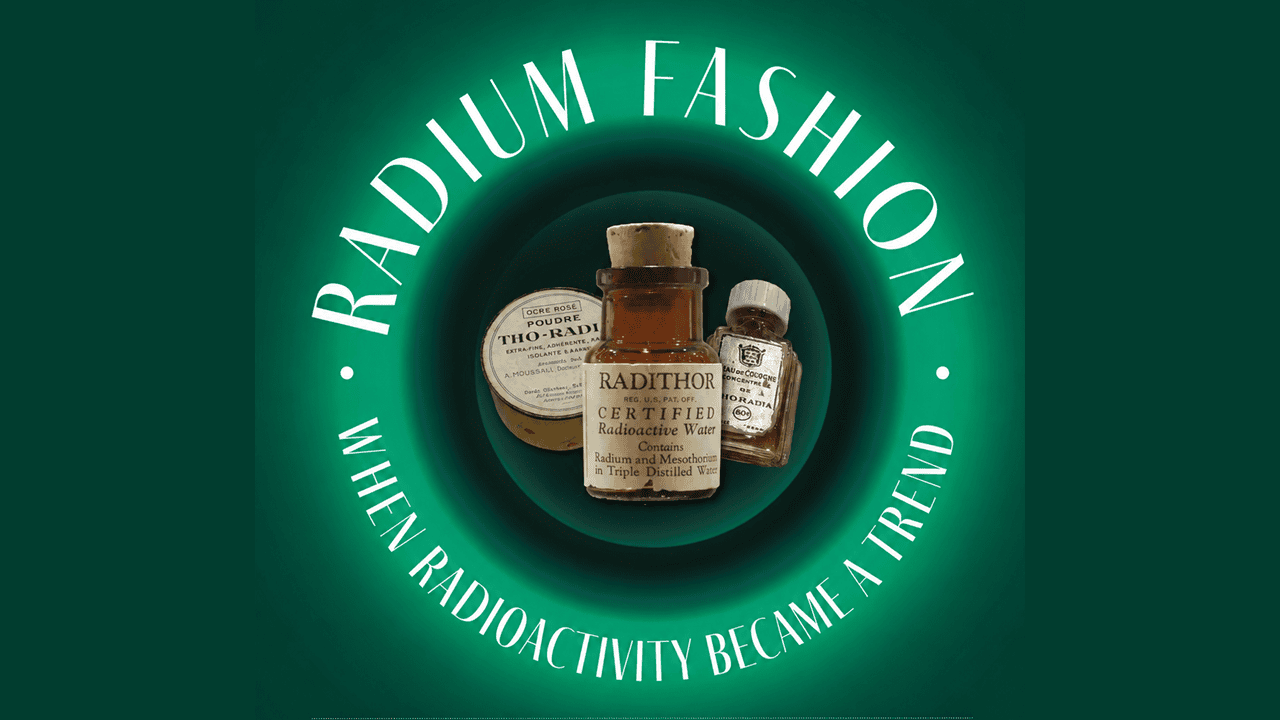
One of the most striking examples was the French brand Tho-Radia, created by pharmacist Alexis Moussali and marketed under the name of a real Parisian physician, Dr Alfred Curie, no relation to Marie and Pierre. Launched in the 1930s, Tho-Radia offered creams, powders, soaps, and toothpaste containing radium bromide and thorium chloride. Across Europe, radioactive products flooded the market: the English brand Radior guaranteed the radioactivity of its face creams for twenty years; the German toothpaste Doramad promised whiter teeth through radiation; radioactive corsets, chocolate, yarn for children’s knitwear, condoms, and even insecticides all carried the radium label.
The most chilling individual story belongs to the American golfer Eben Byers, who, beginning in 1928, consumed between 1,000 and 1,500 bottles of Radithor — a radioactive drinking water produced by the fraudulent William Bailey. Byers enthusiastically shared the remedy with friends, lovers, and racehorses. By 1930, his jaw had begun to disintegrate; bones throughout his body were riddled with holes. He died on 31 March 1932 and was buried in a lead-lined coffin.
Nevertheless, the darkest chapter of the radium era belongs to the Radium Girls — over 800 young women employed by the United States Radium Corporation between 1918 and 1923 to paint luminous watch dials. Instructed by supervisors to point their fine brushes to their lips, the women unknowingly ingested radium with every stroke — radium, chemically like calcium, accumulated in their bones. Within years, jaws collapsed, teeth fell out, and bones crumbled. One woman calmly produced fragments of her own jawbone from a jewelry box in court. Of the hundreds employed, only a handful received financial compensation. The suffering of the Radium Girls became one of the most infamous industrial scandals of the twentieth century.
On 5 March 2026, the Faculty of Chemistry at Adam Mickiewicz University in Poznań hosted the opening of the exhibition Radium Fashion. When Radioactivity Became a Trend, presenting artefacts from the private collections of Professor Izabela Nowak and Professor Tomasz Pospieszny.