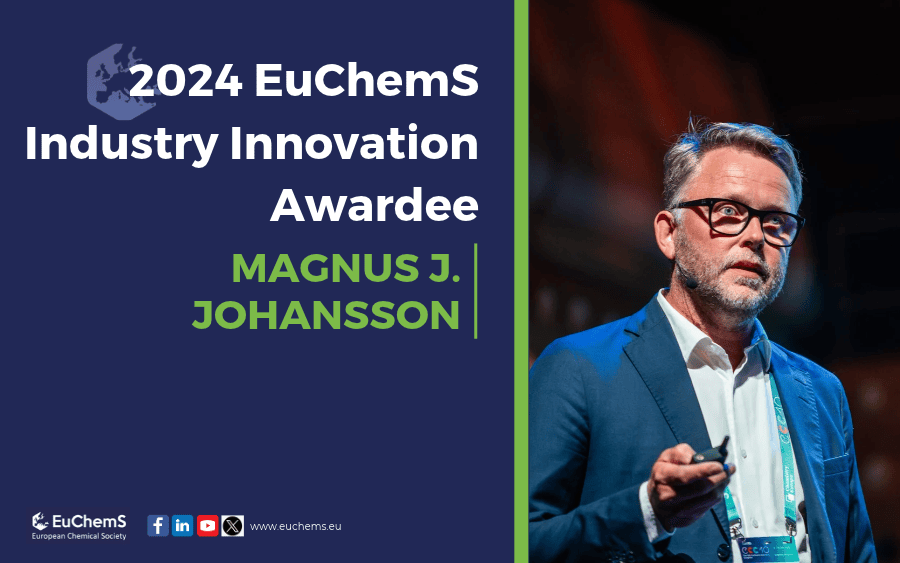
First of all, congratulations on receiving the EuChemS Industry Innovation Award 2024! What does this recognition mean to you and your work in industry?
Thank you. It means a great deal to me, my team and my academic collaborators. For me, the most rewarding part has really been the journey itself. When other scientists appreciate your work or find it useful enough to build on, it feels like you have contributed, even in a small way, to moving science forward. That is something I value very much. It is also encouraging when this work can help support more efficient and sustainable chemistry.
Could you take us through your path into chemistry and industry? What inspired you early on, and how did your career evolve towards pharmaceutical development?
I studied organic chemistry during my master’s and was always fascinated by what could be achieved with metal catalysis. My move into pharma actually came from a very unexpected moment. I met a scientist in my uncle’s barn during hay harvesting, and he spoke so passionately about the role synthetic chemistry can play in drug development. That conversation stayed with me. After that, I applied to Astra Hässle, as it was called at the time. Several research stints in other labs has defined me as a scientists and Im forever thankful for those opportunities along with the possibility to work wit leading academic labs in various areas of synthesis methodology. Looking back, I think what drew me in was the possibility of doing chemistry that could have a real impact on people’s lives, and over time that has also come to include the importance of doing it in a greener way.
Your work at AstraZeneca focuses on developing efficient and more sustainable chemical processes. How would you describe what you do on a day-to-day basis, and what drives your approach to innovation?
On a day to day basis, I work closely with colleagues, PhD students, and postdocs, trying to solve challenges in ongoing projects, while also thinking about longer term scientific questions. I also spend a lot of time interacting with academic groups, both in more technical areas and in fundamental reaction discovery. What motivates me is the chance to help find better ways of doing chemistry, not only in terms of efficiency, but also in terms of responsibility and sustainability, ultimately leading to improved drugs to the market. I feel that the close connection between industry and academia is especially valuable here, because it allows us to learn from each other and move forward together.
In your view, what are the most exciting or impactful innovations in process chemistry when it comes to developing and manufacturing medicines?
First, I should say that I do not really see myself as a process chemist in the strict sense, but more as a medicinal chemist with a strong interest in sustainable and green methodologies. From my perspective, some of the most exciting developments are biocatalysis, new synthetic methods, and advanced manufacturing technologies. What makes these areas so important is that they can improve selectivity, speed, safety, and sustainability at the same time. I find biocatalysis especially exciting, because enzymes can often replace harsher chemistry, reduce waste, and simplify routes. More broadly, areas such as photochemistry, electrochemistry, C–H functionalization, flow chemistry, automation, and real time analytical monitoring are creating very promising opportunities to make the manufacture of medicines both smarter and more sustainable.
Sustainability is becoming increasingly important in the pharmaceutical sector. How do environmental considerations influence the way you design and improve chemical processes?
They influence our work every day. We are constantly comparing routes and thinking about how to reduce the overall sustainability footprint of our compounds. If you look at where we are today compared with ten years ago, the mindset has clearly changed. It is no longer only about process efficiency. We also pay much closer attention to green metrics and to the broader environmental impact of the chemistry we use. We are working actively, both internally and together with academic partners, to replace methods that are less sustainable with better alternatives. The idea of Safe and Sustainable by Design is also becoming increasingly important in drug discovery, and I think that is a very positive and necessary development for the field.
Looking back on your career in industry, what have been the main challenges in driving innovation, and which achievements stand out as particularly meaningful to you?
One of the biggest challenges is that meaningful innovation often takes time. A new idea may be scientifically exciting, but in industry it also has to be practical, robust, and relevant to real projects before it can make a difference. So there is always a balance between scientific ambition and what is needed in practice. For me, the most meaningful moments are when new chemistry moves from being an interesting idea to something that is genuinely useful and can help projects move forward. That feels especially rewarding when it also contributes to making our work more efficient and more sustainable. I also feel very fortunate to have worked with talented colleagues, students, and academic collaborators, because those shared efforts are often what make progress possible.
As we conclude, what would you like readers of EuChemS Magazine – especially young chemists considering a career in industry – to take away from your experience?
Chemistry is incredibly important today influencing society as a whole, perhaps more than ever. If you study chemistry, you have a real opportunity to contribute to society and to the future of our planet in many different ways/areas. My advice would be to stay curious and open minded. Curiosity is such an important part of discovery, and there is still something very special about looking at new data and realising you may have found something new. I also think that, increasingly, chemistry gives us the chance not only to innovate, but to do so in ways that are more thoughtful and sustainable, and that is something I find very encouraging.