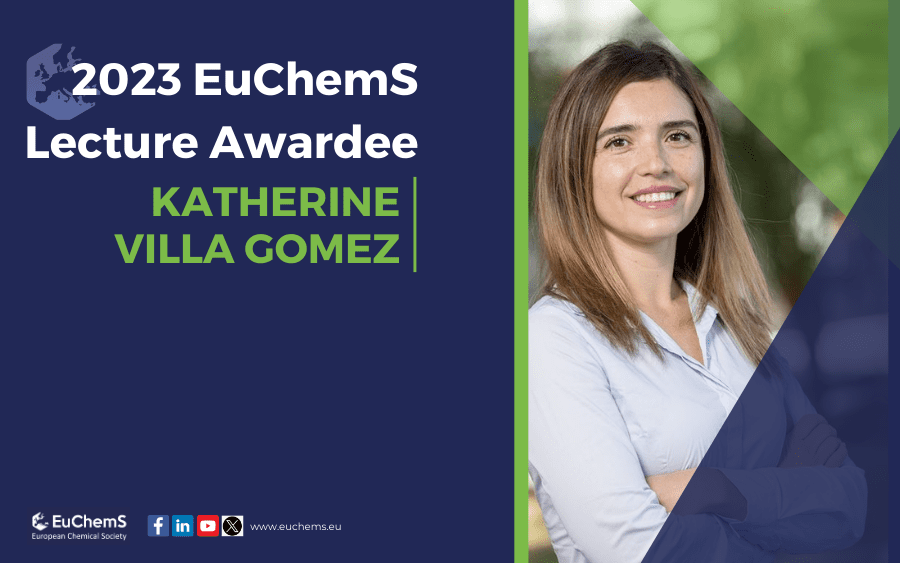
Congratulations on receiving the 2023 EuChemS Lecture Award! What does this recognition mean to you, both personally and professionally?
It is very meaningful recognition for me, especially as a prestigious award at the European level. I have worked on photocatalysis throughout my career, and it is encouraging to see that our work on photocatalytic systems for energy and environmental applications is valued by the broader chemical community. Professionally, the award increases the visibility of my group at ICIQ and helps attract talented students and collaborators. It also motivates me to continue pursuing ambitious ideas, even when they are technically challenging.
What first sparked your interest in science, and what key moments have shaped the path that brought you to where you are today?
Since childhood, I have always been curious about how the world works. I remember experimenting at home when I was a kid, mixing different products to create new colors and textures. Later, in chemistry classes, I realized that my true interest was in understanding how matter transforms. Although my father initially encouraged me to choose another career, I decided to follow my intuition and study chemistry. That decision shaped everything that came after. Through science I have met extraordinary people, travelled to places I never imagined, and built a career that has given me great satisfaction while also pushing me to overcome doubts and fears. Starting my own group at ICIQ, mentoring young researchers, and discovering unexpected phenomena were moments that confirmed I had chosen the right path. Looking back, I feel grateful for that early decision and proud of how far curiosity and persistence can take us.
Your research focuses on photocatalysts and self-propelled micro- and nanomotors for environmental and energy applications. How would you describe the main ideas behind your work to our readers?
My research is about creating nanostructured materials that can absorb light energy to drive chemical reactions in a clean way. We also build tiny moving particles (micro- and nanomotors) that use this light energy to move and interact with their surroundings.
In our group at ICIQ, we study how these materials can help clean contaminated water, detect harmful chemicals, or support more sustainable chemical processes, such as solar fuel generation. Some of these systems are inspired by how photosynthetic microorganisms use light, but we design them to tackle real-world needs. In simple terms, we use sunlight to power new photoactive materials and tiny moving systems that can help address pollution and energy challenges.
In your opinion, what are/could be the most exciting or promising real-world applications of your research?
One important direction is water purification, where these materials and light-powered micromotors can help degrade organic pollutants, remove microplastics, or detect harmful chemicals directly in water. Another promising area is sustainable chemical production, for example using sunlight to convert carbon dioxide or waste molecules into useful fuels and chemicals. Such photocatalytic systems could enable cleaner ways of producing energy carriers while reducing greenhouse emissions. Therefore, we work to improve efficiency and selectivity so these light-driven systems can move closer to more realistic scenarios.
Since your work is connected to environmental and sustainability-related challenges, how do these issues shape the questions and priorities in your research?
These challenges also guide how we design our materials. We focus on systems that can be fabricated using simple, scalable methods such as wet-chemical synthesis or 3D printing, and we try to avoid noble metals whenever possible to reduce costs and improve sustainability. We also place strong emphasis on stability under long-term illumination, since durability is essential for these types of applications.
Every scientific career comes with obstacles. What challenges have you faced along the way, and what achievements are you most proud of so far?
My main challenges were balancing motherhood with a scientific career in such a competitive environment as academia, and moving between countries to gain international experience. After a maternity break, I had to rebuild momentum and rethink my research direction. This led me to explore the use of photocatalytic materials to power micromotors with light, work I began while living in the Czech Republic. Moving abroad with my family was demanding, but it also gave me independence and new opportunities. These experiences taught me resilience, patience, and the importance of hard work and staying focused on clear career goals.
Finally, as we wrap up, what would you like readers of the EuChemS Magazine – especially the next generation of chemists – to take away from your story and your work?
I believe that hard work, resilience, and especially motivation and creativity are essential ingredients for building a scientific career. Progress in research is often slow, and many ideas fail before one works, but persistence and curiosity make the difference. Choose questions that truly matter to you, and don’t be afraid to take risks or change direction when needed.